We saw in the previous section that the Mandelbrot is a useful tool for investigating Julia Fractals.
But we would be doing this fractal, listed in the Guinness Book of Records in 1991 as "the most complicated mathematical object", an injustice if we were to leave it at that.
In this section we want to show a bit of that complexity.
That the Mandelbrot Fractal has a jagged edge is no longer surprising, we had already seen that with the Julia Fractals.
What is surprising is that in the vicinity of the main set (the apple man) there are countless small and even smaller copies of this apple man to be found. |
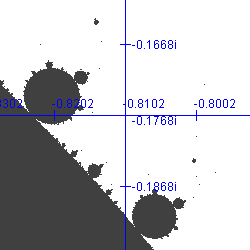 |
In the figure on the left you see an example. A detail is enlarged of the 'valley' between the kidney-shaped 'body' and the 'head' of the apple man.
With this enlargement the 'sprouts' are clearly visible, but you can also see a few small 'spots' and a few more dots at some distance from these sprouts.
When you look closely, you can see with some effort that these are small apple men. |
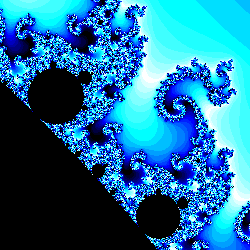 |
When you color the surroundings of the Mandelbrot in this situation in the way described earlier, it becomes clear how fascinating and complex the Mandelbrot Fractal is.
The mini Mandelbrots apparently do not just hang in the air, but are connected to the main set via a complicated pattern of curls and spirals. This is not an illusion. It has been proven that the Mandelbrot set is compact, all mini Mandelbrots are connected to the main figure by means of 'threads'. |
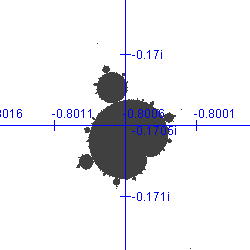 |
Are you still in doubt whether those little spots are real apple men? In the figure on the left, the spot above left of the middle in the figure above is magnified 10 times further. On the right, the same picture but now colored.
Remember that in the vicinity of this Mandelbrot there are again infinitely many even smaller Mandelbrots. | 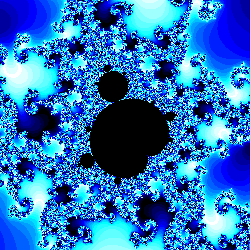
|
Notice that the mini Mandelbrot above is slightly crooked. You often see that with fractals: on a smaller scale repetition occurs, but that repetition does not have to be 100% uniform. Where we do find exactly the same shape is on the antenna that extends to the left in the main set to c = -2
In the two pictures below you see a mini Mandelbrot on this main antenna.
|
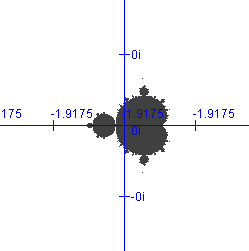 |
The magnification of this image is a whopping 1.6 trillion times!
And that's a lot.
If you could study your desktop with that magnification, you would start to see the nuclei of atoms. | 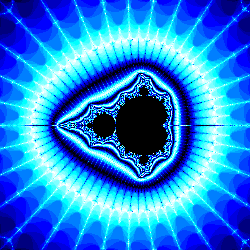
|
|
In the applet below you can further explore the Mandelbrot Fractal.
|