|
| At first glance, there seems to be little of interest to discover about the function
y = x2.
The graph is a parabola that opens upwards with its minimum at the origin.
Calculating the y-value is very easy with a calculator. Enter a number, for example 2 and press the square key. The result is 4, not very surprising. If you now press the square key again, the result of the first calculation is used as input for the second, and that gives the new result 16. If you continue with this, you get 256, then 65536, and after a few more times the calculator gives an error message because the result is too large. |
 |
| We call this process iteration. IYERATION: perform an operation on a number and then reuse the output as input.
If you start with the number 1.5 or 1.01, it will take longer, but as long as the input number is greater than 1, the result goes to infinity
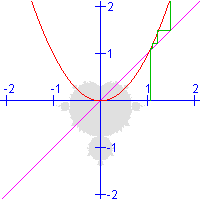
| There is a very nice way to represent this iteration graphically. Remember that we always use the old y for the new x. In the figure, the diagonal is drawn (x = y). We start with an x-value, draw a vertical line up to the parabola (y) and then a horizontal line to the diagonal (new x). Then up (or down) again to the parabola, and so on. |
|
In the figure at the top right we see that the green line shoots away to infinity.
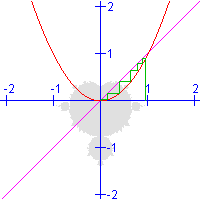
If we start with the number 0.5, things are different. The first result is then 0.25, then 0.0625, and so on, in the direction of 0. This applies to all numbers smaller than 1.
Here too, the process can be represented graphically using the diagonal. See the figure on the right.
And the number 1 itself? That stays neatly in place. It separates the area of numbers that are attracted to 0 from the area that goes to infinity. We call the point 0 an ATTRACTOR
It is easy to see that for negative starting values, all numbers greater than -1 also have the same attractor 0. Numbers smaller than -1 go to infinity again.
|
 |
|
In summary, the parabola y = x2 has an attractor at x = 0, for starting values ??between -1 and +1.
Now let's see what happens when we move the parabola up or down. If you're wondering what all this has to do with fractals, it's not for nothing that Mandelbrot's "shadow" is visible in the two figures!
|
|