|
| Shifting the parabola vertically means that the function becomes:
y = x2 + c.
The minimum of the parabola has a value c.
The question is, what happens now when we iterate this function? The answer can be seen here, where c is chosen to be -0.5. We see that there is an attractor again, but it is no longer zero. The attractor is exactly the intersection of the parabola with the diagonal! The other intersection of the parabola with the diagonal also has a meaning: when the starting value is to the right of this intersection, the iteration goes to infinity. |
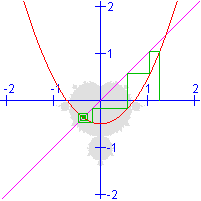 |
The following applies to the intersection points: x = x2 + c
Solving the quadratic equation gives solutions -0.366 and 1.366
In summary:
For c = -0.5, all starting values between -1.366 and 1.366 are attracted to the point -0.366 |
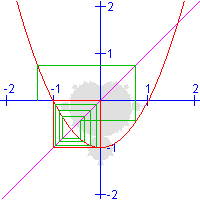
Let's look at the next case: c =-1
The figure below shows something remarkable: the starting value does not go to a fixed point during iteration, but keeps jumping back and forth, in this case between the values 0 and -1 (indicated in red). We call this a double attractor.
Because the numbers here are so simple, you can check it mentally. Take 0 as the starting value. Filling it in the parabola gives the first iteration: -1. If we fill in that value again, we find 0 as the second iteration! with other starting values it may take a bit longer, but even then you will end up with the same double attractor. |
 |
|
The question now is, what happens when we make c even more negative, say -1.3 or -1.5. Do we then get triple or quadruple attractors?
Time to get to work yourself! Below you will find an applet with which you can check all of the above, and much more, yourself.
|
|