After you have completed the tasks using the parabola applet, you may have come to some interesting conclusions.
For exampls:
- When c is less than -2 or greater than 0.25, there is no attractor, every starting value goes to infinity when iterating.
- When c is between -0.75 and 0.25 there is a single attractor.
- There is a double attractor for values ??of c between -0.75 and -1.25.
- If we reduce the value of c even further, we get a small region with a quadruple attractor, followed by an even smaller region with an octuple attractor (try c = -1.39 if you didn't find it)
- If you make the c even more negative, this so-called period doubling stops and something very strange happens: there is still a range of starting value that are attracted, but the iteration does not go towards an identifiable (multiple) attractor. No regularity can be recognized anymore.
We call this chaotic behavior and the attractor that is not there and yet is there, we call a Strange Attractor. A whole new science has developed around this chaotic behavior, the Chaos Theory.
- Even more remarkable: in the chaos region there are still areas where there is a normal attractor. For example, near c = -1.76 there is a triple attractor!
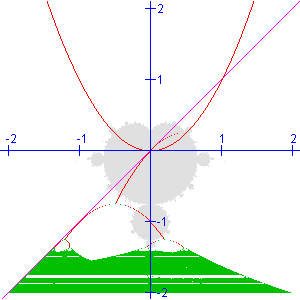 |
All these results are summarized in this graph.
Explanation:
For each value of c the attractors are indicated as red or green points on a horizontal line through c.
For example: for c = -1.00 we had found a double attractor: 0 and -1. If you draw a horizontal line through the point y = -1 you will see that it indeed intersects the tree at the points 0 and -1.
If you draw the horizontal line a little lower, you will pass a branch and you will get four intersection points, etc.
The chaos begins a little deeper: the entire line is green.
But there are (several) places where order appears again.
The one at c = -1.76 is the largest.
For c greater than 0.25 or less than -2 there is no attraction at all.
|
The resulting figure is called the Feigenbaum bifurcation tree and is named after the American mathematician Mitchell Feigenbaum, who did research in this area around 1975. When you turn the monitor upside down, it also looks a bit like a tree.
This Feigenbaum tree is itself a fractal! You can investigate this yourself in the applet below.
By zooming in (using the mouse ) you will discover that in the chaos region there are many small areas of c-values where there are regular attractors. And in those areas period doubling occurs again!
|