Feigenbaum Table of Contents Numbers

5. Chaos
 
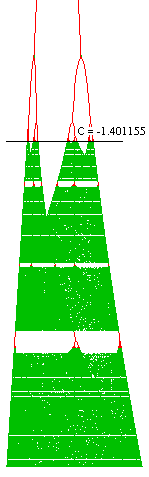
Before we continue with the Mandelbrot Fractal, it is good to pause for a moment to consider the Feigenbaum tree and the occurrence of chaos. The tree is shown here (enlarged in the c-direction and without the 'trunk') once more.

It turns out that the region where period doubling occurs ends at a value of c = -1.401155..
If c becomes even more negative, there are still regions with x-values that are attracted, but no self-repeating pattern results. The attractor has become a "Strange Attractor". The successive iterations produce chaos. Howevery, there are still small 'islands' of regularity in this green chaos region.

What does that mean, chaos?
We call a process chaotic when we cannot predict what will happen.

In the doubling region, everything is predictable.
A starting value of x ends up in a cycle after a number of iterations.
If we choose a different starting value, the initial number of iterations may be different, but you still end up in the same cycle.

In the chaotic region, a starting value of x no longer ends up in a cycle, but jumps back and forth in a chaotic way
When you choose other starting values, even if they are very close to the first one, the iterations quickly start to differ from each other.

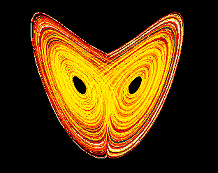
This sensitivity to the choice of the starting value appears to be characteristic of all chaotic systems. The parabola we are studying now is just a simple example. The chaos theory that emerged in the seventies of the last century discovered that chaotic systems occur everywhere. A well-known example of a chaotic system are the processes around air pressure and temperature, which take place in the atmosphere and which determine the weather. The American meteorologist Lorenz discovered at that time more or less by chance that the results of his model calculations became very different when he used input data that were a fraction different.

Extreme sensitivity to the initial value means in practice unpredictability. For example, with the weather system, you can do your best to measure the initial values (temperature, air pressures, etc.) accurately, there will always be some uncertainty. In the past, before chaos was discovered, it was thought that this meant that at most the prediction would not be entirely accurate. But now we know that this initial uncertainty "inflates" and can have major effects on the prediction.

A butterfly that flaps its wings one extra time can be the cause of a hurricane.

This romantic image is found time and again in stories about chaos, because the visual representation of the calculations that Lorenz performed resembles a butterfly.
The mathematics behind these calculations are considerably more complicated than in our simple parabola, but here too there are parameters, twhich determine whether regular or chaotic behavior occurs.

In the applet you will find a simulation of the way Lorenz noticed the "sensitive dependence on initial conditions" as it is called.

Feigenbaum Table of Contents Numbers