|
The parabolic function we studied is a function of x, where x is a number. What kind of number?
In this section we will discuss the different types of numbers that exist.
The first numbers you encounter as a child are the integers 1,2,3...
In primary school this is expanded, first with the number 0 and the negative integers. Sums such as 7 + x = 3 can then be solved, but 7x = 3 not yet. The next step is therefore to introduce the fractions (rational numbers). For example 3/7 = 0.428571428...
We have come a long way, but a sum such as x2 = 2 still has no solution. The number set is therefore expanded in secondary school with "root numbers" or the real numbers such as √2 = 1.41421356...
The question at the beginning of this paragraph can now be answered. Both x and c are real numbers.
There remains one unsolvable sum, namely x2 = -4.
Taking roots from a negative number is not possible.
Can we expand our number set even further so that it is possible?
The answer is yes.
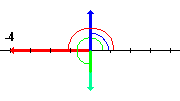
As an introduction, we will first look at calculating numbers in a somewhat unusual way. Let us consider numbers as "vectors", arrows with a length that have a certain direction. We can express that direction in the angle that the arrow makes with, for example, the positive x-axis.
The number +2 is then an arrow with length 2 that makes an angle of 0 degrees with that positive x-axis. Because angles are the same again after 360 degrees, you can also say that the arrow makes an angle of 360 degrees (or 720, etc.)
The number -2 is an arrow with length 2 that makes an angle of 180 (or 540, etc.) degrees with the positive x-axis.
We now agree on "new" rules for multiplying and dividing numbers and for taking the square root and squaring:
| Multiply: | Multiply the lengths of the arrows and add the angles. | | Divide: | Divide the lengths of the arrows and subtract the angles. | |
Taking the square root: | Take the square root of the length and halve the angle. | |
Squaring: | Square the length and double the angle. |
|
Take for example: x = (-2).(-3)
According to the 'normal' rule, the answer is x = +6, because "minus times minus is plus".
According to the new rule: The length of the arrow becomes 6 and the angle becomes 180 + 180 = 360 degrees, so the answer is x = +6
Another example: x2 = 4
Old rule: the answer is x = +2 or -2 , there are two solutions, that was the agreement
New rule: the square root of the length is 2, the halved angle becomes 0/2=0 or 360/2=180 degrees. So two solutions, which follow automatically from the new rule!
Nothing new so far, but let's now look at x2 = -4. Our new rule for taking the square root now gives:
The square root of the length is 2, the halved angle becomes 180/2=90 or 540/2=270 degrees. |