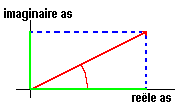
We write the real part of c as Re(c) and the imaginary part as Im(c).
Suppose we find for a complex number Re(c) = 3 and Im(c) = 2.
The number is then often written as follows: 3 + 2i
The solutions to the above sum with this notation are: ±2i , because these numbers were on the imaginary axis and therefore have no real part.
Another example: x2 - 6x + 13 = 0
Applying the abc formula yields, after simplification, that the solutions to this quadratic equation given by 3 ± √-4, so by 3 ± 2i
Finally, a remark:
Be careful not to confuse the real and imaginary axes with the x-axis and the y-axis in the graphs of functions.
The input of one specific x-value yields one specific function value and that is plotted along the y-axis. In the next paragraph, we will study our familiar parabola again, but now with starting values that are complex numbers.
The input then consists of two numbers and the function value will in general also be a complex number.
Drawing a graph of a function is then no longer possible.
High time to go back to the fractals. We are almost there now!
|