|
We are now finally ready to really get started: we are going to iterate our parabola function y = x2 + c again, but now use starting values that can be complex.
For now, we will keep the value of c real. Areas of attraction are now no longer pieces of the number line, but parts of the complex plane. |
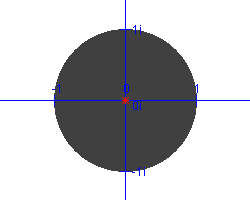 |
In the figures below, the area in which the numbers are attracted is shown in black, and the attractors as red crosses. Let's look again at c = 0. The result is shown here. Actually, it's not very surprising. We saw that all real numbers between -1 and 1 were attracted to the point 0, and we now see that in the complex plane all numbers that have a length smaller than 1 are attracted to zero. | 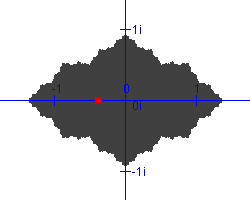 |
It gets more interesting when we look at c = - 0.5 We found there that all real numbers between -1.336 and 1.336 were attracted to the point -0.336.
And that is also visible in the figure to the left. But anyone who expected that all complex numbers with length less than 1.336 would be attracted to that point will be disappointed. It is a jagged figure with an edge that looks ragged. When you enlarge that edge, you will find that it is fractal, the same raggedness remains. | 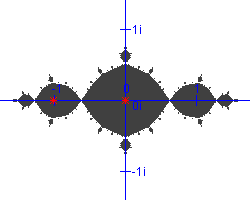 |
Even more surprising is the third situation we looked at, c = - 1. There we found a double attractor with values 0 and -1. And we do find that here, but erratic is clearly too weak an expression for the figure next to it. Don't the 'sprouts' remind you a bit of Mandelbrot?
These kinds of figures are called Julia fractals, after the French mathematician Gaston Julia, who first did research in this area at the beginning of the previous century (and therefore without computers!). | 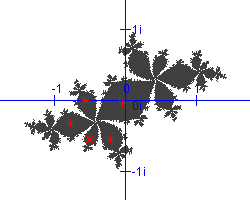 |
Julia fractals are therefore the areas of points in the complex plane, for a given value of c, that do not go to infinity when iterated.
What happens when we also choose a complex number for c itself? On the left you see the result for Re(c) = - 0.5 and Im(c) = 0.55 The irregularity increases further. Now the attractor (a fivefold one in this case) is also complex itself. | 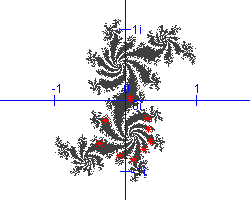 |
Another example, for Re(c) = 0.325 and Im(c) = 0.417. The figure looks a bit like a double dragon and has a nine-fold attractor.
The fractal character is very clearly visible here. |
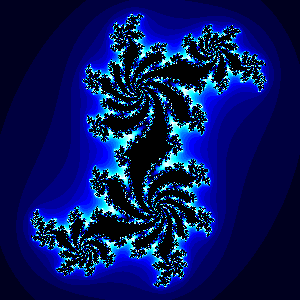
As mentioned, points outside the dark area go to infinity when iterating, and faster the further out they are. This provides an interesting way to color the Julia Fractal. We color the fractal itself black, and in the outer area we determine for each point how many iterations are needed before the result of the iteration (a complex number) has a length that is greater than a chosen limit value. We then give that point a color that depends on this number of iterations.
This is how the figure on the right was created. The c-value is the same as in the figure above
The longer it takes for the iteration to exceed the above limit, the whiter the color becomes. This is how visually very attractive images are created.
|  |
| With the Julia Applet below you can now explore to your heart's content.
|
|