|
You've probably noticed, when experimenting with the Julia applet, that it often happens that you choose a c-value that doesn't produce a fractal. Maybe a nice picture will still come out, but when you increase the number of iterations, nothing remains.
For real values of c it's simple: we've seen that they have to be between -2 and 0.25. It would be nice if we could also see in advance for complex values of c whether a Julia Fractal belongs to it or not.
Does such an overview exist? The answer is yes, see the figure below. |
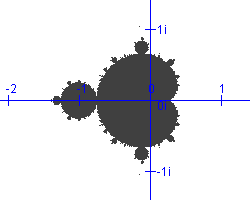 |
Here we finally have the Mandelbrot Fractal. The Mandelbrot Fractal is the set of all complex c-values, which produce regions of attraction (Julia Fractals).
It is named after the originally Polish mathematician Benoit Mandelbrot, who in the 1970s did research that built on that of Julia. At that time it became possible for the first time to make computer graphics.
|
 |
You can show mathematically that, when there is a region of attraction for a c-value, the initial value x = 0 always lies within it.
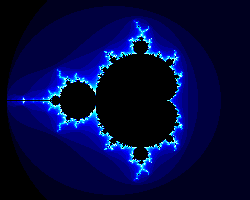
This provides the way to create the Mandelbrot set. For each value of c, we check whether the initial value 0 is attracted during iteration, or goes to infinity. When the point goes to infinity
(and therefore does not belong to the Mandelbrot set), we can again check how quickly that happens, and assign a color accordingly. The result is shown in the figure on the left. |
Before we continue studying the Mandelbrot fractal, you can use the applet below to look at Julia Fractals again, but now supported by the Mandelbrot Fractal.
You will notice how much easier it is.
The applet works just like the previous one, except that you now choose a value of c by clicking with the mouse somewhere in the Mandelbrot set.
|
|